
The Gold Standard in PRP
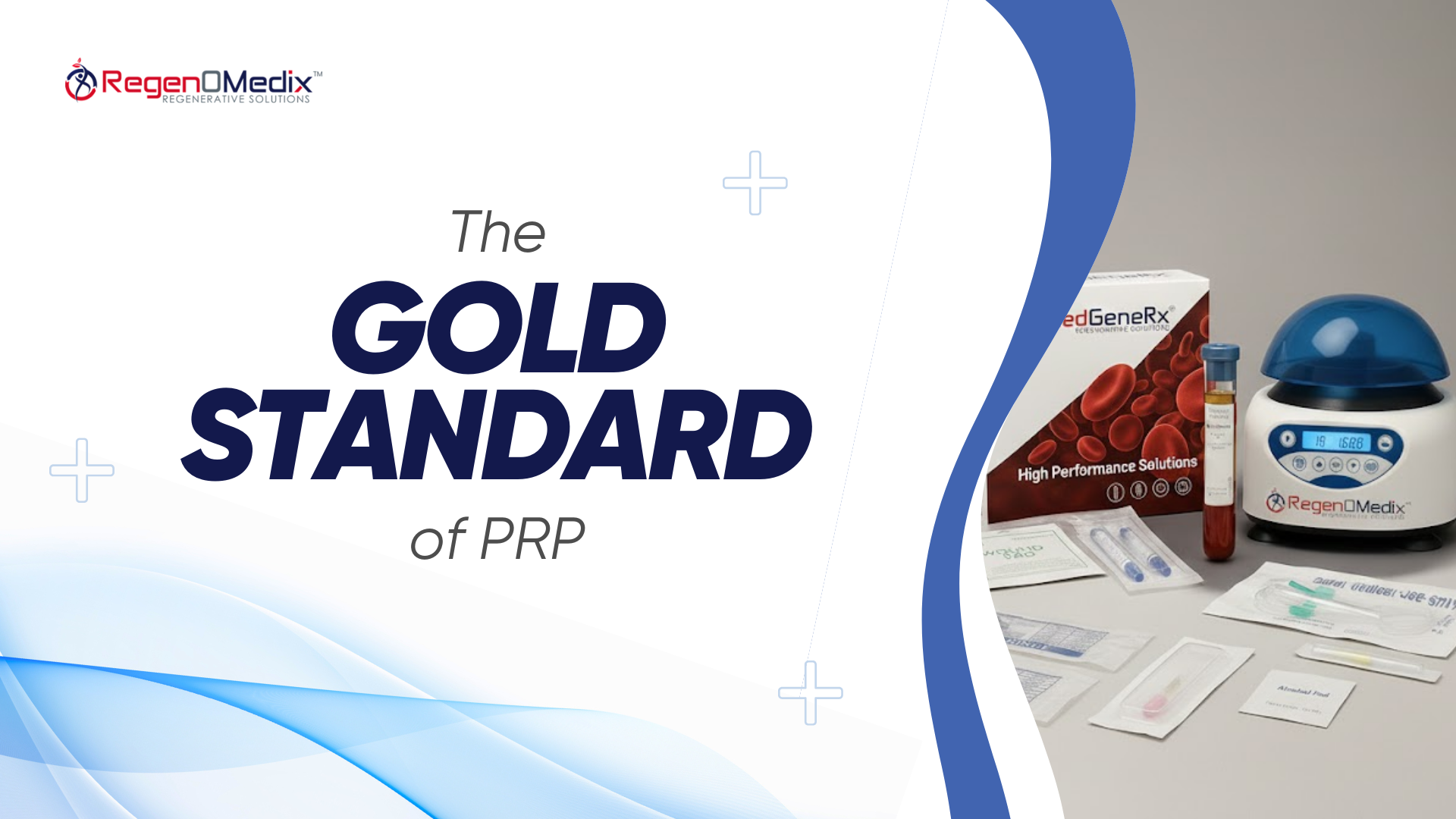
The Gold Standard in PRP
Platelet-rich plasma (PRP) has become a cornerstone modality in regenerative medicine, widely adopted in orthopedics, pain management, aesthetics, hair restoration, wound care, and sexual wellness. As use cases expand, emphasizing systems that consistently achieve> 1 million platelets/μL can enhance clinicians’ confidence in treatment efficacy and safety.
This article provides a clinical framework for evaluating PRP systems that deliver high platelet yields, focusing on performance, reproducibility, and regulatory compliance to support improved clinical outcomes with validated PRP systems.
Why Platelet Concentration Standards Matter
The clinical mechanism of PRP centers on growth factors released by activated platelets, including PDGF, VEGF, TGF-β1, and IGF-1. These agents promote angiogenesis, extracellular matrix remodeling, collagen production, and modulation of inflammation. Research indicates a positive correlation between platelet dose and treatment efficacy across multiple specialties.
Recent systematic reviews and dose-based analyses confirm that platelet-rich formulations yielding approximately 1 million platelets/μL, or total doses exceeding 5 billion platelets per treatment, demonstrate stronger therapeutic outcomes in both musculoskeletal and aesthetic indications. However, commercially available kits vary significantly in their ability to reach these values.
Below is a structured breakdown of the technical and clinical criteria physicians should review when selecting a PRP system capable of delivering such performance.
Key Performance Metrics for PRP System Evaluation
| Metric | Why It Matters | Target Benchmark |
| Platelet Recovery (%) | Efficiency of platelet capture from whole blood | ≥ 80% |
| Platelet Concentration | Fold increase over baseline; linked to therapeutic potency | ≥ 4.0x baseline |
| Platelet Dose | Total biological payload delivered per injection | ≥ 5 billion |
| RBC Removal | Minimizes inflammatory load and oxidative stress | ≥ 99% removal |
| WBC Profile | Indication-specific modulation of inflammation | Controlled or indication-specific |
| pH Stability | Supports platelet activity and patient comfort | 7.4–7.7 |
| Reproducibility | Predictable output across different users and sessions | Validated performance range |
| Workflow Simplicity | Minimizes training burden and operator error | Single-spin, closed system |
| Centrifuge Compatibility | Impacts ease of adoption and equipment investment | Compatible with standard centrifuges |
| Regulatory Status | Confirms validation, compliance, and quality control | FDA 510(k)-Cleared, Class II |
These benchmarks provide a basis for technical comparison across PRP kits. Each category is discussed in detail below.
1. Platelet Recovery
Platelet recovery refers to the proportion of platelets retained in the final PRP volume from the original whole blood draw. A system that fails to recover an adequate percentage of platelets risks producing underpowered PRP, even if the concentration appears sufficient. Recovery rates above 80% reflect effective separation and preparation protocols.
Kits with poor recovery may technically achieve a fold-increase in concentration but waste a significant portion of the biologically active platelet population. When patient baseline platelet counts are low, high recovery is even more critical for achieving the therapeutic dose.
2. Platelet Concentration
Concentration indicates the number of times the platelet count in PRP exceeds the baseline whole blood count. Clinical literature supports concentrations in the range of 4x to 6x baseline, with higher concentrations (approaching or exceeding 1 million platelets/μL) associated with improved clinical outcomes across several indications.
For musculoskeletal applications, such as knee osteoarthritis, these values are associated with improved joint function and reduced pain. In facial and scalp procedures, higher concentrations may drive more robust tissue remodeling and follicular stimulation.
3. Absolute Platelet Dose
Beyond concentration, the total dose, expressed in billions of platelets per injection, influences therapeutic response. Studies highlight that treatments yielding 5 billion or more platelets per application are associated with better outcomes than lower-dose protocols.
This dose is a function of both recovery and final PRP volume. Systems that offer high concentration and volume flexibility provide clinicians with options tailored to procedure size and target tissue requirements.
4. Red Blood Cell (RBC) Removal
RBCs do not contribute to regeneration and are associated with injection-site discomfort, pro-inflammatory effects, and visual contamination of the PRP sample. Kits that fail to eliminate RBCs introduce unnecessary biologic noise.
A target≥99% RBC removal is recommended. This supports patient comfort, reduces oxidative stress in tissues, and contributes to improved purity. Clinically, high-purity PRP is essential in aesthetic and intra-articular applications.
5. White Blood Cell (WBC) Content
The optimal leukocyte profile is indication-dependent. Neutrophils may promote catabolic inflammation, while mononuclear cells may contribute to healing. Leukocyte-poor PRP is generally preferred for aesthetic and joint injections, while leukocyte-rich formulations may be appropriate for tendon applications.
A high-performance kit should allow for controlled WBC content or clearly specify its leukocyte profile. This provides clinicians with flexibility to adapt PRP formulations across different tissue types and clinical goals.
6. pH Stability
Maintaining near-physiological pH (7.4-7.7) is essential to preserve platelet viability and minimize injection discomfort. Acidic PRP may reduce growth factor release and impair patient tolerance. Some systems introduce additives (e.g., ACD-A) that lower pH, requiring buffering or compensation.
FDA-cleared systems that avoid acid-based anticoagulants or maintain stable pH without additives reduce the risk of biologic degradation and procedural complications.
7. Reproducibility
Consistency between operators, patients, and preparation sessions supports clinical predictability. Reproducibility ensures that biologic output does not vary widely, which is especially important in multi-provider or high-volume practices.
Performance data should include standard deviation across multiple preparations and confirm that the kit produces consistent platelet yield and purity regardless of the user.
8. Workflow Simplicity
In busy practices, preparation time, ease of use, and staff training requirements all impact utility. Single-spin kits using closed Vacutainer systems reduce setup time and minimize the risk of contamination.
Complex multi-step kits increase the risk of user error and reduce procedural efficiency. A simplified process also facilitates integration into practices that offer multiple PRP-based procedures daily.
9. Centrifuge Compatibility
Some kits require proprietary centrifuges, increasing startup costs and reducing flexibility. Others are compatible with standard clinical centrifuges, simplifying implementation.
Compatibility affects training, cost efficiency, and cross-specialty compatibility. Systems that integrate with existing centrifuges help providers avoid additional capital investment.
10. Regulatory Clearance.
FDA 510(k) clearance verifies that a PRP device meets validated standards for performance, safety, and quality control. This classification indicates that the device has demonstrated substantial equivalence to the predicate device with respect to reproducibility, platelet yield, and purity metrics.
Kits that are only “registered” or “compliant” lack these performance-based validations. Use of cleared systems also simplifies regulatory compliance and supports clinical documentation for practices operating under strict oversight.
Practical Application for Physicians
When comparing PRP kits, physicians should begin by reviewing the most common indications and identifying the performance metrics most relevant to those contexts. Aesthetic and dermatologic applications may prioritize RBC removal and pH, while orthopedic practices may require high platelet doses and specific leukocyte profiles.
The 1 million platelets/μL threshold is a clinically relevant target across specialties and is supported by the current literature. A system that consistently meets this benchmark, supported by performance data and FDA clearance, is more likely to deliver predictable, high-quality outcomes.
Questions to Ask Vendors
To validate a system’s performance and clinical suitability, providers should ask the following:
- What is the validated platelet recovery percentage?
- What concentration factor does the system achieve?
- What is the average platelet dose per injection?
- How much RBC and WBC content remains in the PRP?
- Does the system maintain biologic pH without additives?
- Is the device FDA 510(k)-cleared as a Class II medical device?
- Is it compatible with my existing centrifuge?
- What documentation supports reproducibility claims?
- What is the total preparation time per treatment?
- Are peer-reviewed studies available using this system?
Final Considerations for Physicians
The shift toward evidence-based regenerative protocols requires PRP systems that meet defined standards of biological performance. Systems capable of delivering 1 million platelets per microliter, with high reproducibility and FDA clearance, offer a measurable clinical advantage. Objective evaluation using structured criteria supports better treatment decisions and more reliable patient outcomes.
As regenerative therapies continue to grow, physicians who invest in validated biologic systems are better positioned to offer treatments grounded in science, supported by performance, and made to address patient needs.